
Chapter 4
Resilience
Effective response is measured in hours and days. A resilient recovery is measured in weeks, months and years.
In the weeks following Melissa, the immediate emergency gave way to a longer, more complex task: the national goal of recovering in a way that helps communities build back better.
Recovery, done well, restarts economies from the ground up, one cleared road, one re-energized home, one repaired fishing vessel, one reopened business at a time. Cash-for-work programmes put income in people's hands while clearing the roads that reconnect communities, and even turning debris into useful items. Repairing a fishing vessel and regaining access to energy restores a livelihood.
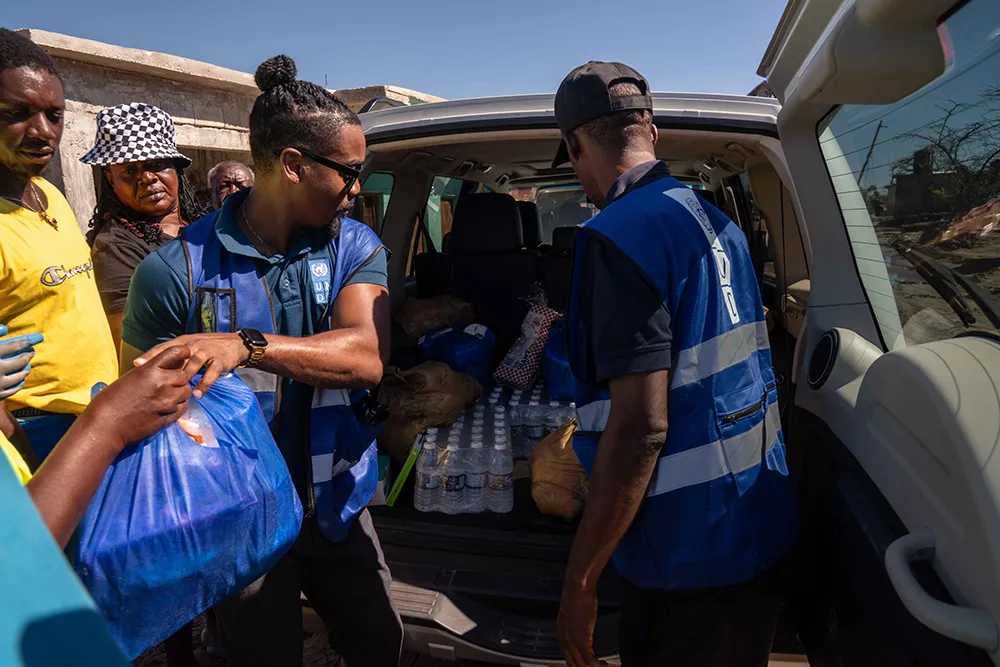
UNDP team members distribute essential supplies in St. Elizabeth parish as part of efforts to support communities affected by Hurricane Melissa and advance Jamaica’s resilient recovery.
UNDP Jamaica/Anorak Productions
A UNDP surge team, under the leadership of Ronald Jackson, head of Disaster Risk Reduction and Recovery for Resilience, was deployed to steer this phase of the work.
"As a disaster risk reduction expert, and as a Jamaican, I have seen first-hand how disasters can erase years of hard-won development gains. Risk-informed development is about protecting these gains by ensuring that investments in infrastructure, services and livelihoods are resilient, reduce vulnerability and exposure, and build community and institutional capacity to manage risks. If unaddressed in normal context, the recovery efforts present another opportunity that should leave communities safer, stronger and better prepared for future shocks." – Ronald Jackson, Head of Disaster Risk Reduction and Recovery for Resilience, UNDP
In consultation with Government partners, UNDP launched its flagship Jamaica Resilient Recovery Initiative with an initial $2.4 million in grants building on immediate crisis response allocations and complementary contributions from the CARICOM Development Fund, the European Union and Australia. This included $717,000 from the ACP-EU Disaster Risk Governance project covering four priority areas: recovery governance, a Human Impact Assessment and Risk Driver Analysis, a national Recovery Framework and Plan, and the establishment of Technical Assistance Centres for community-level support. The UNDP-implemented GEF Small Grants Programme in Jamaica was also mobilized in the early months after landfall, providing civil society grants to help communities recover corals, mangroves and other foundations of coastal livelihoods.
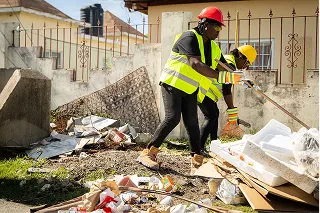
Paid community employment to clear, repair and restore, keeping money circulating locally while rebuilding collectively. Roads reopened, communities reconnected, access to schools, clinics and markets restored.
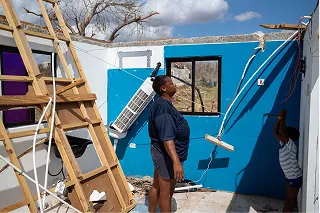
Damaged homes restored. Critical public infrastructure assessed and prioritized for repair.
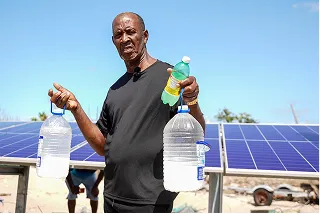
Targeted support to deploy decentralized solar solutions for farmers, fisherfolk, tourism-dependent workers and small business owners, the backbone of Jamaica's economy.
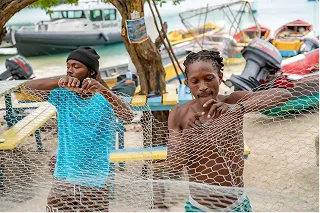
Rehabilitation of mangroves and coastal zones that serve as natural buffers against future storms.
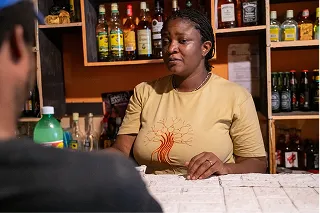
Dedicated support for women-owned enterprises, people with disabilities and others who face the steepest barriers to recovery.
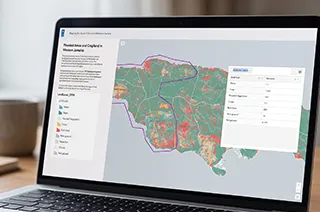
AI-based modelling and geospatial tool RAPIDA used to identify areas of greatest damage and displacement, ensuring resources were directed where they were needed most.
In Jamaica, nearly 60 percent of small and micro enterprises are women-owned, and one in three farmers is a woman. When a hurricane strikes, these women do not just lose their businesses. They shoulder the burden of caring for their families, supporting their communities, and rebuilding local economies, often with little help.
Post-Melissa, in support of national Government efforts, UNDP dedicates specific resources to supporting women business owners, including women with disabilities, poultry farmers, vegetable growers and shop owners across Clarendon, Manchester and St. Elizabeth, providing grants and targeted training to help rebuild their operations and better withstand future shocks.
This work builds on a resilient recovery model created after Hurricane Beryl in 2024, when 54 women business owners across the hardest-hit parishes received the same support. This time, recovery was faster because the groundwork was already laid. The Japan-Caribbean Climate Change Partnership and agriculture grants in earlier years also had impact, as many farmers already had access to practical tools for climate-smart farming and support networks before Melissa arrived.
"By enhancing business skills, promoting financial literacy and improving access to resources, we can strengthen the ability of women-led businesses to withstand future crises." – Kishan Khoday, Resident Representative, UNDP Multi-Country Office in Jamaica
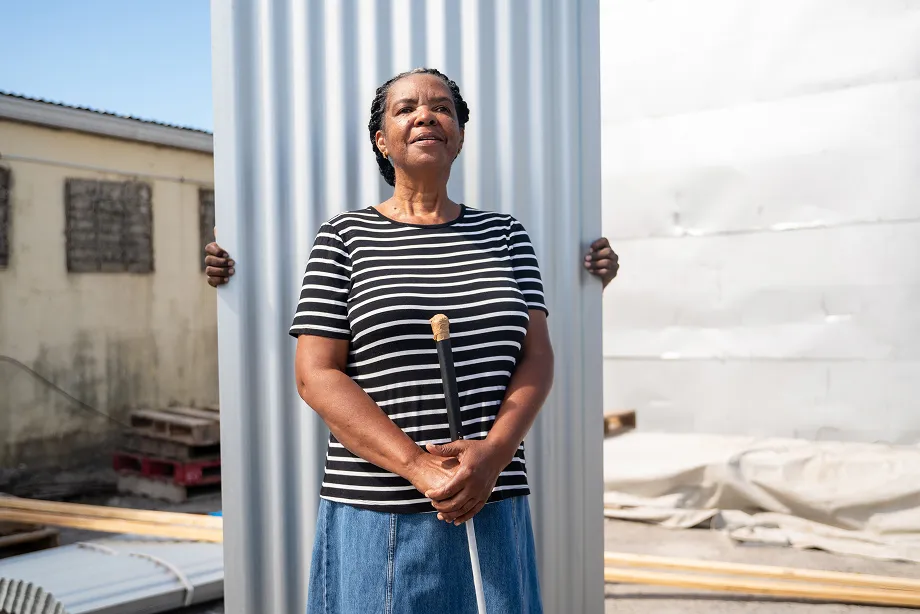
Villette Neil, a blind poultry farmer, received new chicks to rebuild her poultry business after Hurricane Melissa killed her chickens and damaged their coop.
UNDP Jamaica/Anorak Productions
Up and down the coast of western Jamaica, the loss of power meant refrigerators stopped working, and tonnes of seafood rotted. Partnering with the Ministry of Agriculture and National Fisheries Authority, UNDP set up two solar energy centres equipped with chest freezers, Starlink internet and charging stations in fishing villages in St. Elizabeth, restoring livelihoods and building resilience against the outage. UNDP is now expanding these solar energy hubs to three additional locations supported by the Government of Australia and the European Union, while a larger-scale solar for recovery initiative with $2 million support from emerging economy donors is soon to be launched, reaching over 5,000 people across affected regions.
In addition, UNDP and the Government will mobilize support under a $50 million portfolio of green initiatives UNDP implements in Jamaica, with funding by GEF and public-private co-financing, to support integration of green solutions in tourism sector recovery, forest ecosystem restoration and other critical needs. More than half of Jamaica’s rich forests were badly impacted by Melissa, while close to a quarter of critical coastal mangrove ecosystems were affected. With key sectors like agriculture and tourism depending strongly on nature, a green recovery will be vital for a resilient future.
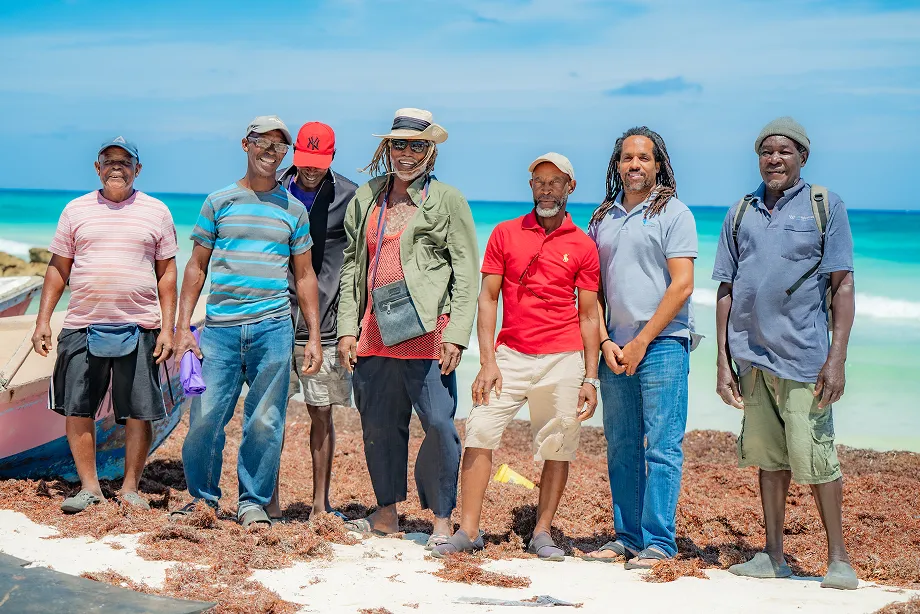
Fishers in Duncans, Trelawny, where power outages disrupted cold storage and led to post-harvest seafood losses. The community is developing plans for a fish sanctuary to strengthen coastal protection and food security against future shocks.
UNDP/Kane Inc Media Photo
Post-Melissa, UNDP is using its existing country programme as the backbone of support to the national recovery framework in a way that does not just rebuild what was lost but also reduces what could be lost again. That means supporting Jamaica’s efforts at recovery planning, disaster-resilient construction standards, nature-based solutions including restored mangroves, rehabilitated coastlines and reforested hillsides, strengthened early warning systems, and communities that are even better equipped before the next storm watch is issued.
Behind every cleared road, every restored livelihood, every vessel back at sea, every restored ecosystem, there is a network of partners whose long-term commitment makes it possible. Leadership of the national government and local civil society is fundamental, with UNDP assistance geared to enhancing their capacities. Core donor contributions give UNDP something no single project can: a long-term presence, the ability to carry forward lessons learned and models to future crises, the freedom to redirect resources immediately and the capacity to act before a crisis is declared, during the storm and through the long months of recovery that follow.
This is UNDP's mission, in Jamaica, across the Caribbean, and in over 170 countries and territories around the world.
Thanks to its partners, it is supporting people before, during and after crisis. Not for a season. For the long term.